
Spice Jar RFQs: Confirm the Compartment Insert
For wholesale spice jars with several compartment options, confirm how the internal layout changes before approving the offer. Yueran’s Spice Jar page describes removable dividers and two-, three- and four-compartment configurations. Its detail imagery also shows a compartmented inner unit being lifted. Ask whether the quoted version changes layout through separate dividers, interchangeable inner units or another supplier-defined arrangement, then identify the configuration the buyer will receive.
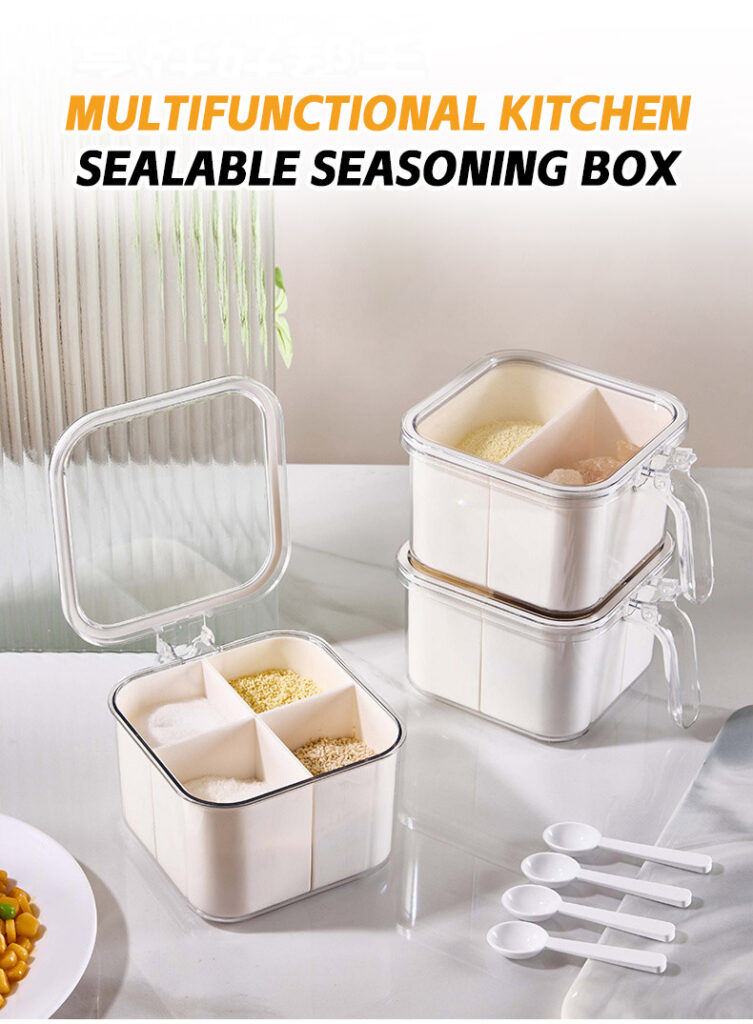
Official Spice Jar PDP composition showing different divided interiors. Use the visible arrangements to identify the configuration being discussed; the scene does not establish a supplied multi-box set or included spoons.
Connect the wording with the actual inner parts
Keep the actual Spice Jar product link with the enquiry and ask the supplier to label the outer body, inner unit and any separately removable divider. A simple marked view can explain which physical part the catalogue calls a divider and which part is lifted as a complete assembly.
The useful purchasing answer is a description of the offered construction. Ask the supplier to identify its product reference and any relevant inner-part references. Keep those names consistent across the drawing, sample and quotation so a generic term such as “insert” does not refer to different pieces in different replies.
Request a layout view for every offered option
Ask for a top view of each proposed compartment arrangement. The published numbers identify layout options, but do not explain whether all three can be produced with the same submitted parts. Request the supplier’s actual explanation rather than building a conversion procedure from the number of spaces visible in one photograph.
Catalogue layout
Clarification requested
Two compartments
Identify the inner unit and divider arrangement
Three compartments
Explain which parts change from the other layouts
Four compartments
Match the arrangement to the proposed sample
Separate official comparison panel. The divided boxes at right provide layout references; the jars at left are comparison imagery, not the offered SKU or evidence of comparative performance.
Distinguish adjustment from exchanging an inner unit
Ask the supplier to show how a change between two offered layouts is made. Identify whether a part is repositioned, removed or replaced, and which reference is used after the change. The response should make clear whether the buyer is selecting one layout or buying a version with several confirmed arrangements.
If another inner unit is required, ask whether it is part of the proposed offer or a separately quoted item. Keep an optional unit visibly separate until the supplier confirms its relationship to the actual outer body. A shared catalogue photograph should not substitute for that product-specific explanation.
Confirm the internal arrangement the buyer needs
Where the buyer needs particular compartment proportions, request a marked internal drawing for the selected layout. State the relevant access or space requirement and ask the supplier which measurements describe it. The page’s listed 16.9 × 13 × 9 cm dimensions should not be turned into individual compartment dimensions by assumption.
Ask how the inner unit sits in the outer body and which orientation the proposed drawing uses. Use the same orientation when marking comments on a sample photograph. That lets purchasing discuss a particular space or divider position without relying on an ambiguous left-or-right description.
Official detail panel includes a compartmented inner unit being lifted. Ask the supplier how that unit relates to the stated removable dividers; lid, seal and rinsing demonstrations are not independent tests.
Review the submitted configuration together
Request the actual outer body and proposed inner arrangement together as the sample reference. Ask the supplier to identify the layout represented and any additional parts submitted with it. Review the construction against the marked drawing and return questions against specific part references or positions.
Identify the outer body and inner unit.
Name the selected compartment arrangement.
Mark separately removable or alternative parts.
Retain the drawing and sample revision.
If the supplier demonstrates more than one arrangement, label the views separately. Keep the buyer’s decision clear about which layouts were reviewed and which remain open. A sample showing one arrangement does not explain another layout that has only been named in the quotation.
Quote the delivered layout and any alternatives
A focused enquiry can read: “Please explain how your two-, three- and four-compartment spice-jar layouts are achieved. Identify the inner units or divider parts, show the proposed sample layout and quote any additional configuration parts separately.” Send it through the supplier contact page with the product link and marked catalogue reference.
Ask the quotation to name the arrangement supplied at delivery and connect it to the accepted sample. When an alternative insert is proposed later, request its reference and a clear explanation of the change. Keep the decision attached to that proposal before reusing an earlier configuration approval.
For multiple order lines, retain the layout reference against each line. This gives the receiving team an identifiable internal arrangement to compare with the order without reconstructing the supplier’s whole catalogue scene.
Keep the evidence boundary clear
The compartment wording and dimensions are supplier declarations; no sample was assembled or measured for this article. Images do not prove interchangeability, equal compartment capacity, separation of contents or an included accessory set. The material and seal descriptions do not establish food-contact suitability, airtightness, moisture protection or cleaning results. Obtain separate product-specific evidence for any required outcome.
Frequently asked questions
Does the listing prove one unit makes all three layouts?
Ask the supplier which actual parts and product version achieve each arrangement.
What should the configuration sample identify?
The outer body, inner unit, divider arrangement and matching drawing revision.
How should an alternative insert be handled?
Identify and quote the changed part, then obtain a buyer decision for that proposal.
spice jarscompartment layoutsinner unitssample approval