
Prep Rack RFQs: Match Heights to Tier Versions
How should a folding prep-rack enquiry map height options? Ask the supplier to associate each listed size with an actual tier arrangement, model reference and measurement state. The catalogue gives three different height figures with a common length and width. It does not provide a complete size-to-tier schedule, so a buyer should not assign the heights to versions by guesswork.
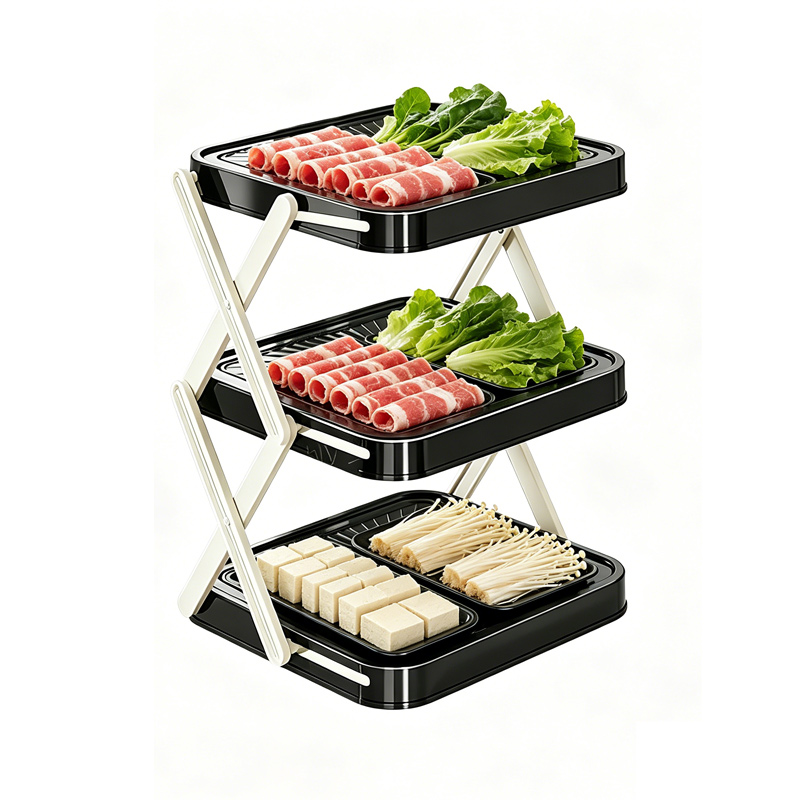
Official photographed arrangement. The three-tier image does not alone map the listed heights to versions or establish capacities or supplied food.
Retain all three listed size expressions
The Folding Food Prep Rack listing gives 25 by 20 by 14.5 cm, 25 by 20 by 26.5 cm and 25 by 20 by 39 cm. It also describes a folding multi-tier design and lists PP plus ABS as the material field. Retain the complete supplier size expressions rather than copying only the height numbers.
For buyers sourcing wholesale food prep racks, the practical next step is a supplier-confirmed version map. An official three-tier image identifies a photographed arrangement, but it should not silently determine which size line applies. A matching tray appearance does not establish the contents or height of every offered version.
Connect each size line to an actual configuration
Ask the supplier for an identified product view or drawing for each proposed size line. Request the actual tier count and assembly reference associated with it. Keep a distinct row for every version the supplier actually offers, even when length and width appear to be shared.
Do not assign one, two and three tiers to the three heights without the supplier’s response. The source mentions stacking and folding in general terms, but that wording does not establish a buyer-configurable system or prove that a single supplied set produces all three arrangements.
Supplier presentation graphic, not an independent space-saving or food-performance result. It does not supply dimension endpoints.
Identify the measurement state and endpoints
Ask the supplier which condition each size describes and where its measurements begin and end. Retain the applicable assembled, folded or other manufacturer-defined state with the drawing. A size line without a state should remain a clarification item rather than becoming an assumed storage dimension.
For height, request marked lower and upper endpoints on the actual arrangement. Keep the unit and configuration reference together. Do not calculate usable shelf clearance from overall height, or assume that a difference between two listed heights equals one repeatable tier spacing.
Use a size-to-tier response worksheet
The worksheet turns the three catalogue size lines into questions for the supplier. It is not a completed version schedule or an instruction for stacking, folding or changing the rack.
Buying field
Requested supplier response
Catalogue size line
Full supplier expression, including 25 by 20 cm and the stated height.
Actual version
Supplier model or configuration reference for the selected size.
Tier arrangement
Confirmed tier count and an identified complete-product view.
Measurement state
Supplier-defined condition in which the dimensions apply.
Height endpoints
Marked lower and upper reference points and applicable unit.
Supplied assembly
Actual included tray and support arrangement for that version.
Separate overall size from local usable space
If container clearance matters, ask for the relevant local dimension on the applicable version. Keep the measurement endpoints and the shelf or tier reference with the value. The overall 25 cm length and 20 cm width do not supply an unobstructed tray area or a guaranteed fit for particular bowls.
Likewise, the catalogue food props provide no usable scale or capacity result. Identify the buyer’s intended container separately if a fit response is required. Retain any supplier drawing, physical observation or later sample review under its actual scope rather than presenting the general catalogue image as an approved loading arrangement.
Supplier detail references for an actual version question. Folding, stability and freshness text are not accepted test results or universal features.
Keep the material and feature records distinct
The earlier PP-and-ABS enquiry maps the structured material field to components. That component-material question does not identify which of the three height lines belongs to a particular tier arrangement. Keep the records linked to the same version without using a common material field as a version code.
The general product description also refers to features that some models may have. Do not assign a non-slip pad, snap-lock detail, stability claim or food-contact result to every size. Request any relevant actual feature with its version reference and keep a supplier statement distinguishable from an unperformed assessment.
Carry the version map into the current quote
Ask the supplier to use the confirmed size and configuration reference on the quotation and corresponding product documents. If it revises the support or tray arrangement, request the changed dimensions and state reference. Preserve the previous response as history instead of letting a similar picture carry an old size association into a new offer.
Send the selected rack link and worksheet through YR contact. Existing kitchen supplied-unit and clearance work covers other records. This enquiry supplies the separate three-size-to-tier identity map, without inventing a load rating, assembly procedure, nesting capability or a verified fit result.
Buyer FAQ
Do the three heights prove one-, two- and three-tier offers?
Ask the supplier to confirm the actual mapping and product reference for each size.
Does overall height establish shelf clearance?
Request local clearance dimensions with marked endpoints for the relevant version.
Are the size lines folded dimensions?
Retain the supplier-defined measurement state; do not infer it.
Can one picture specify every listed version?
Request an applicable identified view and response for each offered configuration.
Supplier response checklist
Actual product and supplier-defined version
Applicable component, configuration or dimension references
Provided evidence and unresolved fields retained separately
wholesale food prep racksB2B supplier sample record